Optimism for Humanity
Introduction: Why are we here? What am I even doing?
As I was growing up, attending school, trying to get good grades, and preparing myself for “the real world,” I often felt bewildered and wondered what the point of it all was. Am I really supposed to get a desk job and work 40+ hours per week for 3,000 weeks (if I’m lucky) and then die?
My father taught me from a young age the importance of hard work. I spent ten years working with my dad every weekend, landscaping in nearly every weather condition imaginable. It was grueling, back-breaking work, and there were times I picked up so many sticks I would see them in my dreams that night.
But I saw firsthand the appreciation our customers expressed when they had a lovely landscaped home to share with their friends and family. I took immense satisfaction from starting the day facing the overgrowth to ending the day evaluating a meticulously sculpted landscape.
Work can be meaningful, I thought, especially if you like the customer and enjoy the job. Meaningful work doesn’t necessarily mean fun work, though.
My mother worked in healthcare my whole life and loved helping real people medically. She saw the transformative power quality of care can have on a family, probably almost daily. However, the bureaucracy and administrative work took a toll on her. It was the kind of work that seemed only partially fulfilling. And she is one of the lucky ones!
You hear stories and see people all the time who do not like their jobs or align with their apparent function in society. Family, friends, and mentors likely advised them to find stable jobs and function within those roles until they had enough money saved up in the bank to retire.
And yet, for so many people, retirement doesn’t seem to get any closer, no matter how hard they work or their personal sacrifices. Let alone retirement, most young people seem concerned about being able to afford a home and start a family.
We work 8 hours a day to enjoy 5 hours in the evening.
We work 5 days a week to enjoy 2 days on the weekend.
We work 48 weeks a year to enjoy 4 weeks of PTO.
We work 45 years to enjoy 10 years in retirement.
It seems so wrong; painful, even. It’s not the life I want to live nor see my friends or family live. But is there anything else in life? I had to search deeper.
Finding roots with family
My grandfather taught me the importance of family from a young age. From as young as I can remember, I always felt tremendous excitement every Christmas when my family in New Hampshire took vacation time off work and traveled to see my mother’s family in New Jersey. I always remember it being one of my favorite weeks of the year. But why? Maybe there is something here.
My grandfather, Pop Pop, as I called him, would bring the family together and tell stories from his youth, and each one was filled with laughter and love. His eyes would squint, his face would wrinkle, and he’d burst into a contagious laugh that everyone around him couldn’t help but smile and laugh too. Too often would we wipe joyful tears from our eyes or leave the family function with abdominal pain from all our laughter.
We didn’t know any of those people, but he made the experiences feel as real to us as they were to him. By way of sharing these deeply personal and meaningful stories, he brought countless joyful experiences back into our lives.
Making other people happy made Pop Pop happy. He lived to love.
From a young age, I learned that while work can give us purpose, it is not the only source. When I look past the humdrum of busyness and labor, what has stuck with me for years as the most energizing and deeply fulfilling experience is laughing and loving with friends and family. When I last saw my Pop Pop in rehab, all that mattered to him was his family and the memories he was able to create by being a loving father and active member of his community.
I have argued this at more length, because the story we get told about connection is mostly wrong.
Essay
Why I Don’t Believe in the Loneliness Epidemic
I think we are diagnosing the symptom and calling it the disease: people are not short of company, they are short of the places company used to happen.
During his burial ceremony, the entire city of East Rutherford witnessed one of the largest police parades I have ever seen in my life. On his final day, just like all his other days, Pop Pop touched the lives of so many people.
It was so special and deeply emotionally moving. So now I come back to my original question, am I really going to work a 9-5 for the rest of my life and then die?
Is working and paying rent all that life has to offer?
After ten thousand years of progress, is this really the pinnacle of the human experience?
There has to be more. So I searched for more. And I found it.
I found a deeply enriching optimism for humanity, and it starts with service.
I’d like to provide some perspective to help us understand why we work, so that we can understand how to escape it. Join me as we deconstruct the universe and come to appreciate how we arrived here.
Where we came from
In case you haven’t heard, our universe is unfathomably large, and yet the only evidence of life is here on Earth. Despite our relentless search across the cosmos, Earth remains the sole sanctuary of life that we know. This fact alone invites us to marvel at the series of extraordinary events that enabled life to flourish here against astronomical odds.
Consider the fragile chain of occurrences that led to our existence:
- the formation of Earth itself in a habitable zone where temperatures allowed liquid water
- the collision with a Mars-sized body that gave us the Moon, which appears to have helped keep our axial tilt, and therefore our seasons, relatively steady
- a molten iron core generating a magnetic field strong enough to deflect the solar wind, without which the atmosphere would have been stripped away as Mars’s was
- the emergence of life from simple organic compounds through a series of chemical reactions that have yet to be fully replicated or understood
- the leap from inanimate chemicals to the first single-cell organisms
- these cells evolving complex structures such as the nucleus, enabling genetic material to be stored and transmitted to future generations
The list goes on. This development of cellular reproduction set the foundation for all complex life. Each step of the way made our existence increasingly likely yet staggeringly improbable.
The very fact that we exist is only possible because each of our ancestors until the beginning of time fought for their lives for survival.
The very first humans who lived in tribes, much like other animals of their time, were terrorized by predators and forever in pursuit of prey. There was no medicine and no sanitation. Thomas Hobbes famously imagined life before society as “solitary, poor, nasty, brutish, and short,” and while anthropologists rightly argue that he was describing a thought experiment rather than any real people, the part nobody disputes is the last word. Life was short.
However, unlike other creatures, humans possess a unique ability among all other known forms of life: the capacity to bend our environment to our ambitions. Early humans who were weary of battling the elements built shelters. These shelters provided safety, which in turn allowed for the accumulation of food and water resources. With safety and sustenance secured, leisure time became possible, and it was leisure that birthed culture.
You scale this innovation across thousands of human tribes worldwide, and you witness the formation of little pockets of society. Our ancestors toiled away their lives, sacrificing their time to build technologies and share knowledge, ensuring the next generation would have it better. Humans have always recognized their suffering and worked tirelessly to alleviate it for others, a true labor of love.
Today, we stand on the shoulders of these giants. Through billions of years of evolution, humanity has arrived at a point where our nature allows us to transcend basic survival. Every step in science, and every act of collaboration, moves more people toward a life they would actually choose.
And the very act of being conscious, of matter becoming aware of itself, seems to defy all known laws of physics.
Looking at our modern society, realizing the amount of progress that has compounded is almost unbelievable.
We had the problem of cold, so we invented warmth. We had the problem of darkness, so we invented light. We had the problem of starving, so we invented agriculture. We had the problem of moving, so we invented transportation. We had the problem of communicating long distances, so we invented the Internet. We now have a problem indexing the internet, so we are building artificial intelligence in the form of models and transformers.
I wrote about what that last one does to work back when it was still a question rather than a product.
Essay
Essay: On Automation
An undergraduate look at what automation does to labor markets, kept online unchanged because I think it is worth seeing what I believed at the time.
Even without acknowledging the innovations in healthcare, education, or countless other industries, it is clear that our ancestors invented so much infrastructure to make human coordination at a global scale possible.
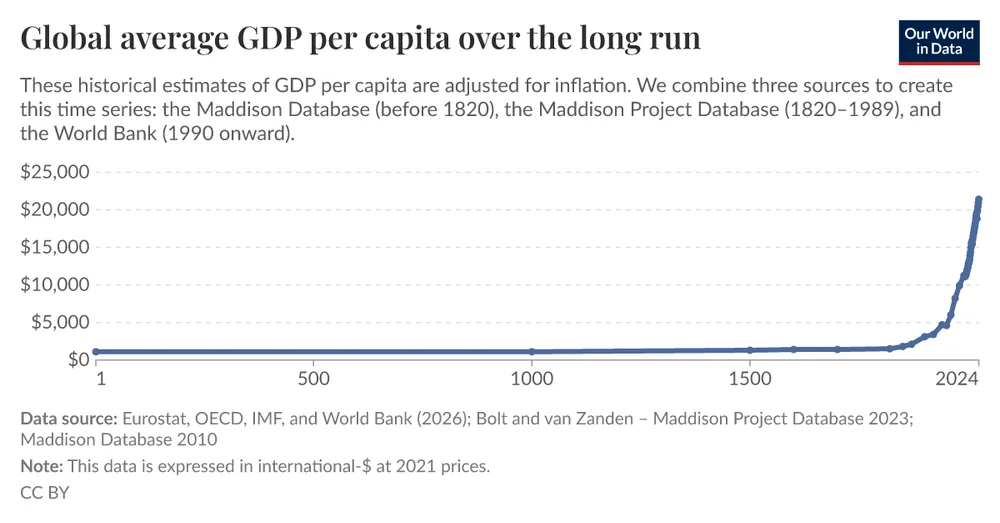
As Noah Smith wrote in The elemental foe, GDP is a proxy for humanity’s success in fighting the unflagging foe that is poverty. GDP is much more than just a line on a chart, but understanding its directionality is critically important for appreciating our trajectory and acknowledging where we came from.
Global average GDP per capita over the long run
These historical estimates of GDP per capita are adjusted for inflation. We combine three sources to create this time series: the Maddison Database (before 1820), the Maddison Project Database (1820–1989), and the World Bank (1990 onward).
Our World in Data
Why do we care about money?
Money is one of the most interesting concepts that is misunderstood by most people. I’d like to break down its power, for we must understand money to understand why people desire it.
Along the way to civilization, humans developed currency to track social credits and debts. We use debt to keep track of who owes us something. We issue currency to reward people for the value that they create. It’s society’s way of saying; we appreciate what you did with your labor; we now owe you something; here is some currency for you in return. You can use that currency to get something back from society in the future.
We effectively trade money for our time back. Ultimately, the money we spend is someone else’s income, their time commitment, and a new opportunity for them to spend on increasing their standard of living, ad infinitum.
The lack of money makes things very difficult. You can certainly build a shelter for yourself for cheap, but you’ll trade hundreds of hours of your life. You can hunt and gather sustenance in the wild for free, but you’ll also trade countless hours of your life.
Healthcare is the best example of this. If you can’t afford to pay to clean your teeth, you may find yourself required to pay for a root canal next year. Can’t afford a new mattress? Next year, pay for back surgery. Can’t pay to get that lump checked out? Next year, pay for stage 3 cancer. Poverty charges interest.
For these reasons and so many more, people tend to orient their lives around making money. Paying for incidentals while preparing for future liabilities. How we decide to spend our money is our authentic expression of self. It will look different for everyone, and that’s the beauty of the human spirit.
However, one thing is certain: there will come a time when we die. All excess money at this point lives on, either used by your family, donated to causes of your choosing, or appropriated by governments to (hopefully) give back to its people.
Some people realize the finiteness of it all and take the opposite position, believing there is no point in making money at all since the result of a life concluded is taking none of it to our graves.
But they miss the obvious reality that your money gets recycled into society. Other people inevitably are beneficiaries of the work you did to earn that money. The first law of thermodynamics is a formulation of energy conservation law: energy cannot be created nor destroyed, only transferred. In the case of money, it is created when there is human demand. The more humans, the more potential for value creation. The economic energy held by your monetary instruments is ultimately demanded by someone, somewhere, sometime.
If human life is so special, why are so many people hurting?
What’s The Problem? - Joe Bryan
A clear, compelling explanation of why so many Americans struggle financially despite living in the world's wealthiest nation. The definitive video on monetary policy and its human cost.
YouTube
I hope so far to have set the stage by highlighting just how special all life is, but especially human life, for the unique abilities we possess. Not only is our existence a miracle, but we have also managed to coordinate and grow our society to a scale where anybody can find a job doing almost anything, earn money for the work they complete, and use that economic energy to live authentically.
However, it’s no secret that people are suffering. Consider all the memes and posts online about people never being able to afford a home, young people blaming elders for the state of the economy, and feelings of overall despair.
The very fact that most people expect to work most/all of their lives shows me that there is a huge misunderstanding about how to save money. Let’s break that down next.
Saving money and beating inflation
There are some excellent podcasts that delve into the history of money and monetary policy; you might find them more informative than this brief summary can offer. I have added links to the end of this section.
The US government aims for the dollar to lose about 2% of its value every year. This target is seen as “optimal” for economic growth. It has not held to that. Consumer prices have risen roughly a quarter since January 2020, which works out to something near 3.7% a year compounded, well above the target and concentrated in the years when it hurt most.
Even at exactly 2%, the erosion is relentless. Five years takes about 9% of your purchasing power. Ten years takes 18%. Fifty years, which is roughly the span of a working life plus a retirement, takes 63%. Those are not projections about a crisis. That is the system operating as designed.
Many people build their savings with USD in traditional bank accounts, which rarely yield returns above 2%. While their account balances grow nominally, they don’t feel wealthier because their purchasing power declines. As a result, despite increasing nominal prices, assets like real estate, which retain value against a depreciating currency, appear to become increasingly expensive.
This erosion of economic participation can feel like wealth is being quietly siphoned away. This dynamic fuels pessimism about the future, explaining why many feel that securing a comfortable retirement requires over 40 years of career effort.
I have written the long version of this argument separately, including what I actually did about it. If you only read one other thing of mine, read that one.
Essay
The Energy of Money
Money is a technology for storing human energy, and the one most people use leaks, which is why a lifetime of work can still feel like standing still.
If you would rather hear it from people who know more than I do, these two are the best explanations I have found.
Michael Saylor: Bitcoin, Inflation, and the Future of Money | Lex Fridman Podcast #276
Michael Saylor discusses Bitcoin as a store of value, monetary inflation, the history of money, and why he believes Bitcoin is the apex property of the human race.
YouTube
Lyn Alden’s Masterclass On Money
Lyn Alden delivers a comprehensive masterclass on monetary history, the nature of money, inflation, and how to think about preserving purchasing power over time.
YouTube
The other half of the story
For a long time, that was most of what I thought about. Protect the savings. Beat the erosion. Do not let the bucket leak.
And it is true. But on its own it produces a kind of strange, cramped optimism, where you feel clever for having a hedge but still expect the world to get worse. I felt that way for a while. But anxiety with a strategy is not actually optimism.
Here’s what I was missing.
Inflation happens to your money. Progress happens to the things you buy.
Those are two different processes, running at the same time, in opposite directions. One is a policy choice about a unit of account. The other is eight billion people getting steadily better at turning energy into useful things.
Take the most ordinary object in your house. A light.
For almost all of human history, light was expensive. Before agriculture, buying a thousand lumen-hours of it, roughly what one modern bulb gives you over an evening, cost more than fifty hours of labor, most of that spent gathering wood. By 1800 it was about five and a half hours. By 1900, after gas lamps and the first filament bulbs, about thirteen minutes. By 1992 it took less than half a second of work.
That comparison is William Nordhaus’s, and it is one of the few places where somebody carefully measured a thing we all assume is free.
Origin story
The Switch
You flip it without looking. Follow the power back and it does not stop at the power plant.
Sit with the size of it. Measured in the only currency that ultimately matters, the hours of your life you have to trade away, light became something like four hundred thousand times cheaper.
Nobody voted for that. No agency was assigned to deliver it. It happened because an enormous number of people, almost none of whom ever met, kept finding better ways to capture energy and turn it into photons. Whale oil to town gas to filament to fluorescent to LED, each step run by people solving their own small problem.
And light is not special. It is just the case somebody bothered to measure properly.
Solar modules cost about $106 per watt in 1976 and about $0.38 per watt in 2019, a decline of more than 99%. The pattern is regular enough to have a name: every time the world’s installed solar capacity doubles, the price of a module falls by roughly a fifth. It has done that for four decades without being told to.
In 1820, around three-quarters of everyone alive was in extreme poverty. Today it is closer to one in twelve. That is not a rounding error in the human condition. That is the single largest change in ordinary experience that has ever happened, and most of it happened recently enough that your great-grandparents watched it.
So there are two clocks running on your life, and they are not measuring the same thing. One is quietly draining the dollars in your account. The other is quietly making almost everything those dollars can buy cost less of your life.
Watch only one clock and you become someone with a hedge and no hope. Watch only the other and you get robbed while feeling good about it. I want to watch both, and I think most of the despair I see comes from people who have only ever been shown part of the story.
Why the progress clock keeps ticking
It’s not magic and it’s not guaranteed. It comes down to three things stacking on each other.
We keep getting access to more energy. Fire, then draft animals, then coal, then oil, then the grid, then splitting atoms. Every step gave us a bigger budget of work we could do without a human body doing it.
We keep getting better at coordinating. Prices, contracts, shipping containers, standards, the ordinary boring machinery that lets a stranger’s effort reach you without either of you knowing the other exists.
And we keep accumulating knowledge that does not die with the person who found it. This is the quietest of the three and possibly the most important. A method, once written down and checked, is available to everyone forever.
I find this so much more interesting than the money argument that I ended up writing a separate set of pieces about it, tracing ordinary objects back through the machinery that delivers them.
Series
Origins
Four ordinary things, followed back through the machinery that delivers them, all ending in the same place.
Now let me speculate, and you should treat what follows differently from everything above it, because the paragraphs before this are measured history and the next few are a guess.
I think the same three forces are about to arrive somewhere they have not been. Housing is still built roughly the way it was built a century ago, by skilled people on a site, one at a time, which is why it costs what it costs. Surgery still depends on a specific tired human hand being available in a specific room. Both of those look to me like problems that energy, machines, and accumulated method eventually eat, the way they ate the price of light.
If that is right, then a lot of what currently feels permanently scarce is not permanently scarce. It is just expensive for now, in the same way light was expensive for ten thousand years right up until it was not.
Housing has a second half that surgery does not, and I should be honest that it is the harder half. Even if a machine could put up a house for a tenth of what one costs today, a town still has to allow it, and permission has turned out to be far harder to manufacture than lumber. The reasons a town says no are usually not frivolous ones.
Underneath the zoning is something harder still. People move to a quiet town because it is quiet. Wanting to keep it that way is the same freedom, exercised by whoever got there first, that the person trying to move in is exercising now. I do not think there is a villain in that. I think it is one of the few genuinely hard problems we have left, and no amount of cheap energy dissolves it, because it was never really about the cost of lumber.
I could be wrong about the timing, and I might be wrong about the mechanism. I am not wrong about the direction, because the direction is the one thing the last two centuries actually settled.
Here is one place that already matters, and I have money in it, so let me point the argument at myself.
A mortgage is the one spot where the money clock runs in your favor. The debt is fixed in dollars and the building is not. You send the same number every month for thirty years, and that number quietly means less every year, without you doing anything at all. Most of the case for borrowing to buy is right there.
But the progress clock does not care whose side it is on. If energy and machines eventually eat the cost of construction the way they ate the cost of light, then houses get cheaper to make, and something cheap to make is a weak place to store value. In a place people already want to be, the scarce thing is permission rather than the structure sitting on it. So I hold property for the leverage and the rent it produces, not as the thing standing between me and inflation.
Essay
Why pursue real estate?
Becoming a renter made me realize someone else was profiting from my need for a roof, so I went and learned how the other side of that transaction works.
What this means to me
Reflecting on the life around me, I feel privileged to have been born healthy and able-bodied. I’ve worked diligently to maintain my health as I age, supported by the education and social skills imparted by my parents and teachers, who taught me how to leverage resources effectively.
Not everyone shares these advantages, and I view my life as a profound gift. This perspective prompts a pivotal question: “What do I want to do with my temporary gift of life?”
The short answers I keep coming back to are collected in one place.
Note
Guiding Mantras
A short list of the phrases I actually return to when I have to decide something, most of them handed to me by people who are no longer here.
While young and full of energy, I am driven to make a meaningful contribution to society. I am deeply aware of the many benefits I received growing up, transforming from a dependent child to an independent adult. I am committed to ensuring that society’s investment in me yields a positive return.
I used the Internet to learn about available jobs and used labor prices (via compensation) to determine which careers capture the most economic energy, meaning the jobs society needs most but cannot get enough of given the resources and technology available.
While the highest-earning jobs tend to be the most demanded by society, many require intensive education or expensive equipment. Using the Internet, other jobs can be learned and completed from home. We each get the opportunity to learn what is out there, find something we can enjoy, and commit to it.
While young, I want to work hard to accrue economic energy that I can use to realize future liabilities like raising a family, having various life experiences, and trading my time back to one day retire completely.
I am here to tell you that there is a way to pursue our dreams without working until we die, and the path to it has already been extensively documented.
Please allow me to share my top-level thoughts:
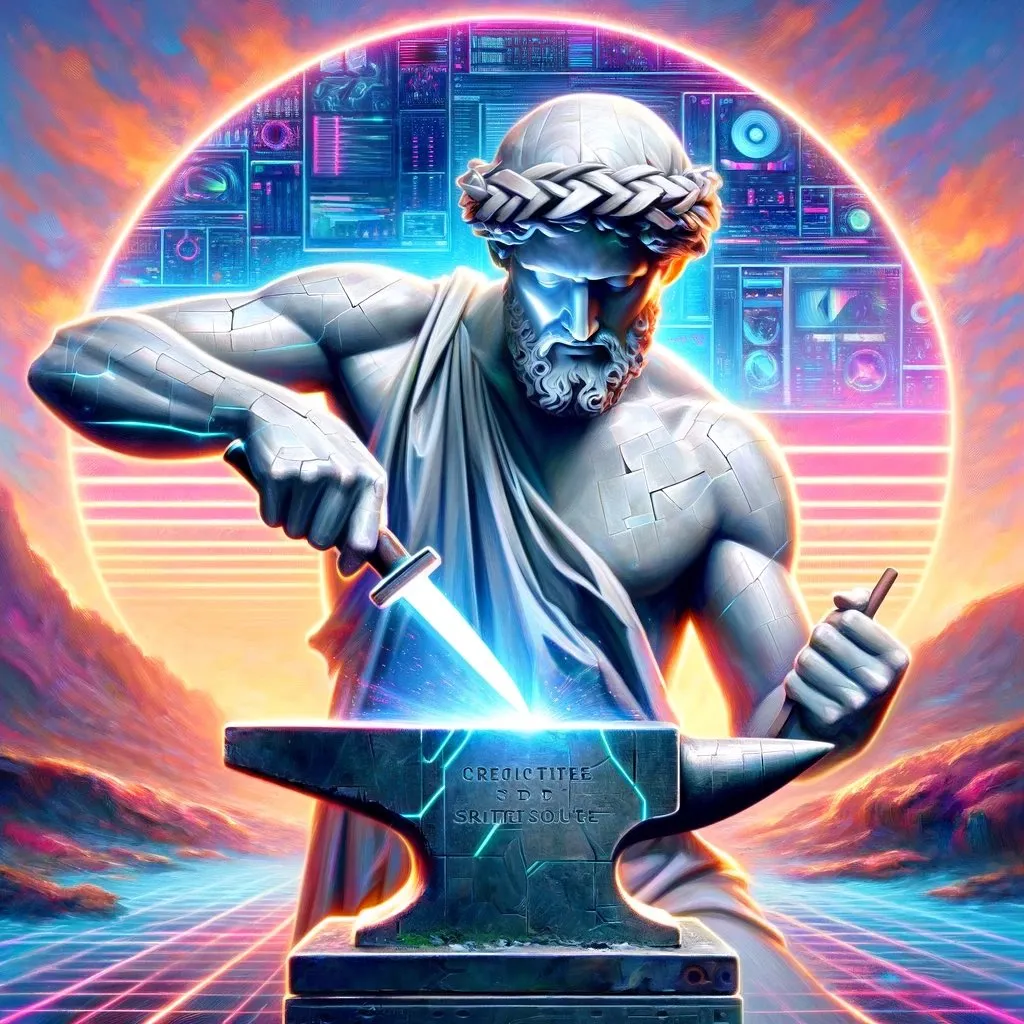
Optimism for humanity
IterIntellectus on X
Tweet about investing in humanity and long-term optimism.
X (formerly Twitter)
I learned about the Internet and its educational content to increase my earning ability.
I learned about gold and its store-of-value properties as a finite resource.
I learned about equities and their value-capture properties as enterprises that produce goods and services people buy.
I learned about index funds and their ability to make it trivially easy to own every publicly traded company in the world, proportioned and rebalanced automatically.
I learned about debt and that you can lend out money you don’t need today for someone else to use today and provide you with interest in return tomorrow.
I learned about real estate and how it appreciates in value while producing cash flow, contributing to public goods via taxes, and creating employment opportunities for local communities.
I learned about Bitcoin, a new technology that natively puts gold’s store-of-value properties on the Internet without the burdensome costs of storing and moving it.
And then, later than I should have, I learned that all of that is only the defensive half.
I learned that the grid I plug into is running on machinery almost nobody can describe, kept within a fraction of a hertz of correct, every second, for my entire life.
I learned that the reason I can buy fruit grown four thousand miles away is not that somebody planned it, but that a few million people each solved one small piece of the problem for their own reasons.
I learned that the medicine in my cabinet is trustworthy not because I understand it, but because a procedure for telling truth from wishful thinking was invented, written down, and handed to everyone.
Put both halves together and the picture changes. Durable assets keep your past effort from evaporating. The machine keeps making your future effort go further. You need the first so the second one reaches you.
I yearn for a world where everyone bets on humanity. A world where everyone seeks to contribute to society, level themselves up, be helpful, and spread love.
Imagine a world where people are financially literate enough to understand how to protect their hard-earned purchasing power and then use that power to self-actualize their dreams.
Everyone can be the master of their calendars.
We can find purpose in working for others and even greater purpose in working for ourselves.
We only work when we want to on projects we feel especially passionate about.
By being prudent in reducing and removing financial stresses, we take back our time and put our lives into our own hands.
We can spend that precious time with other human beings. Sharing stories, making new ones, laughing, loving, and deeply experiencing our one shot at this life.
How to retire
First, we need to create an economic surplus in our lives by spending less than we make. My father always called this “living beneath our means.” Do absolutely whatever it takes to create a meaningful surplus. That could mean cutting expenses, working multiple jobs, or pursuing education to gain the qualifications for a higher-earning job. We want to create excess to save for later because, as we discovered earlier, the goal is not to work forever.
Retirement is just the point where your passive income covers your spending. You get there by lowering one or raising the other, and the mechanics of doing that are boring, well documented, and not really what this essay is about. I have written them up properly elsewhere.
Essay
Your Financial Rocket
There is a threshold where your assets carry your expenses without you, and almost nobody is told that reaching it is a solvable engineering problem.
What matters here is the part underneath the mechanics. Every generation before ours had to work until they physically could not, because there was no durable place to put the surplus and no machine steadily making their money go further. We have both. That is new, and it is worth more attention than it gets.
Although I am currently in the phase of life where I am building up that wealth engine, I aspire to live my ideal life every day. I fill my weekends and evenings with quality time with others. I fill my weekdays with high-value work to, over time, allow me to step back from needing to work a full 40 hours per week.
Perhaps one day, I can afford my basic needs with only 30 work hours per week. Then 20, 10, …
Over time, I aim to spend less time working for strangers and more time working to bring up the people I love and appreciate.
I aspire to create and use wealth to elevate people and communities.
I aspire to create and use wealth to dedicate my time to laughing, loving, and experiencing this life.
Because there will come a time when I die, and all my economic energy flows back into society. All that will be left of me is my memory. And when all the people who knew me die, there will be nothing left but my durable contributions to society, just like my millions of ancestors who came before me.